Gutter Ladder Safety & Roof Access Guide Oahu | FBC Hawaii
Image Source Pets World
Gutter Ladder Safety & Roof Access Guide Oahu | FBC Hawaii
The Technical Standards of Professional Access
Why We Use Gutter Standoffs (Stabilizers)
The Physics of the 808: Leveling & Pitch
Beyond the Rung: The FBC Guide to Safe Roof Access & Gutter Protection
In the roofing industry, a ladder isn't just a tool—it’s a liability or a safeguard. Most property owners don't realize that the leading cause of gutter failure isn't actually rain; it’s improper ladder placement. Leaning a ladder directly against a gutter puts hundreds of pounds of pressure on a non-structural aluminum lip, leading to bent metal, broken seals, and compromised Gutter Services.
At FBC Roofing & Exteriors, our "Foundation of Life" philosophy extends to how we access your home. We treat roof access as a technical discipline, ensuring that our presence on your property never leaves a "dent" in your investment.
The Technical Standards of Professional Access
When FBC Hawaii arrives for Roofing Services or a detailed audit, we don't just "lean a ladder and climb." We utilize a suite of equipment specifically engineered to mitigate Hawaii’s unique architectural and environmental challenges. From the steep, uneven terrain of Manoa and Palolo to the high-UV exposure and overhead lines of the Ewa Plain, every piece of gear is selected for a specific purpose.
By adhering to these higher hardware standards, we ensure that the structural envelope of your home remains uncompromised from the very first minute we step onto your property.
Why We Use Gutter Standoffs (Stabilizers)
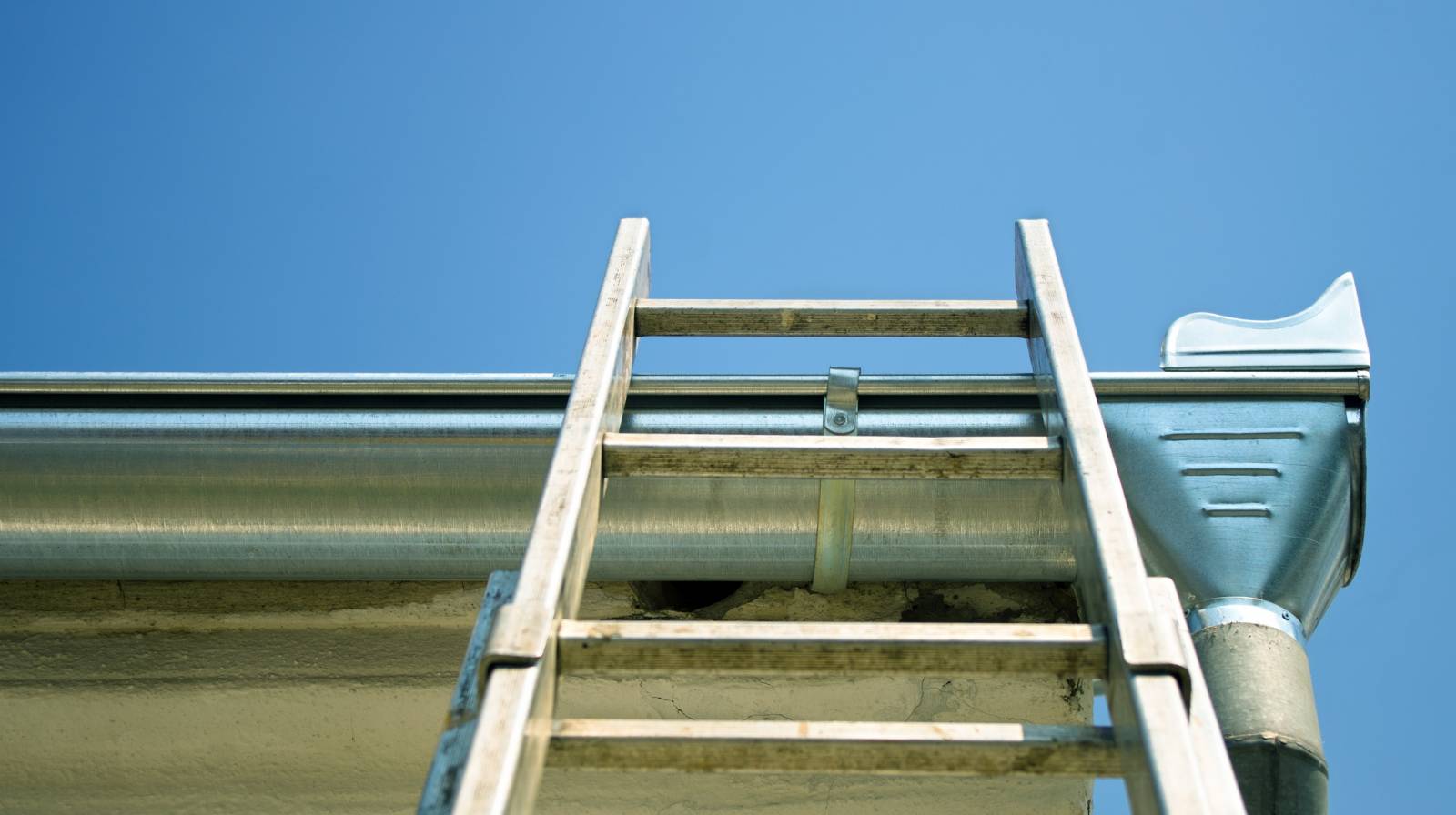
The most common—and expensive—mistake in Hawaii roofing is the "Direct Lean." Standard seamless gutters are designed to handle the weight of rainwater (approximately 1.2 lbs per linear foot), not the concentrated, 200+ lb point-load of a technician and their equipment.
Load Distribution & Structural Integrity: Our teams utilize U-shaped Standoff Stabilizers. These professional attachments bridge over the gutter run entirely, resting the ladder’s weight against the structural fascia board or the home’s siding. This shifts the pressure from a fragile aluminum lip to a load-bearing structural member, reducing the direct pressure on your home’s exterior by up to 800%.
Safety & Lateral Slip Prevention: Standard ladders are prone to "sliding" along the gutter edge if the technician shifts their weight. By creating a wider mechanical "footprint" at the top of the ladder (up to 36 inches wide), we eliminate side-to-side wobbling. This stability is critical when navigating the sudden trade wind gusts common on Oahu's windward side.
Surface Protection: We understand the value of your Siding Services. Our standoffs are equipped with non-marring, heavy-duty rubber end caps. This ensures that while we access the roof, your paint, cedar, or vinyl siding remains free of scratches, dents, or black scuff marks.
The Physics of the 808: Leveling & Pitch
Hawaii’s natural beauty often presents significant logistical hurdles. Accessing a roof in a valley neighborhood or on a hillside property means dealing with grade changes that make standard ladder use dangerous.
The 4-to-1 Rule (The OSHA Standard): To maintain the "Goldilocks Zone" of stability, we follow a strict ratio: for every 4 feet of vertical height, the base of the ladder must be exactly 1 foot away from the wall. This creates a 75.5-degree angle. If the angle is too steep, the ladder can tip backward; if it is too shallow, the base can "kick out" on slick, tropical grass.
Precision Terrain Leveling: In many Oahu yards, one ladder leg might be on a concrete walkway while the other is in a soft garden bed. We never "shim" a ladder with scrap wood, bricks, or debris—a common cause of catastrophic ladder failure. FBC uses integrated Mechanical Leg Levelers. These heavy-duty extensions compensate for up to 10 inches of grade change, ensuring the rungs are perfectly horizontal even on the steepest Manoa slopes.
Electrical Awareness: Many older Oahu neighborhoods feature overhead power service lines that run dangerously close to the roofline. Our choice of Fiberglass is a non-negotiable safety standard. Unlike aluminum, fiberglass is a non-conductive material, providing a life-saving dielectric barrier that protects our team and your property from accidental electrical arcing.
Work You Can Trust
“FBC did an exceptional job replacing my roof. I had some wind damage, and they worked with my insurance company, the Homeowner’s Association and me to get the new roof approved and installed. Everyone I dealt with was friendly and professional, the workmanship was good, and they started and completed the job when they said they would. I am very happy with the quality of the work and the quality of the people.” - Alex D on Google Review
Professional Access & Gutter FAQ
For more details on our standards, visit our FAQ page.
1. Why does FBC insist on using fiberglass ladders? Safety is our first priority. Fiberglass is non-conductive. In Hawaii, where power lines often run close to rooflines or through trees near the house, using aluminum is an unnecessary risk that a professional outfit won't take.
2. Can leaning a ladder against a gutter cause leaks? Yes. Even if it doesn't visibly "crush" the gutter, the pressure can pull the hangers away from the fascia, creating a gap where water can seep in and rot the wood behind your Siding Services.
3. What is a "Ridge Hook" and when is it used? For steep-slope Roofing Services, we use hooks that roll over the peak of the roof. This allows us to work on high-pitch homes safely without putting any weight on the fragile eaves or gutters.
4. How do you handle ladders on "Post-and-Pier" homes? These homes often have higher access points and softer ground underneath. We use oversized base plates and mechanical levelers to ensure the ladder doesn't sink or tilt during an inspection.
5. Is a ladder standoff necessary for a single-story home? Absolutely. The height doesn't change the strength of the gutter lip. Whether it's 8 feet or 20 feet, the gutter is not a structural support and should never be used as one.
Authority in Every Step
Safe roof access is a hallmark of a professional contractor. At FBC Hawaii, we don't just "show up"—we arrive with the engineering and equipment necessary to protect your home from the ground up.
Need an expert, damage-free inspection?