
Attic Ventilation Guide Oahu | FBC Hawaii
Oahu Microclimate Roofing Guide | FBC - Copy
How Roof Ventilation Works: The Science of Airflow
The 1:150 Ventilation Rule Explained
Choosing the Right Ventilation System for the 808 Climate
The Cost of Poor Ventilation: What Happens When Roofs Can't Breathe
Signs Your Attic Ventilation Is Inadequate
Common Ventilation Mistakes to Avoid
Is Your Attic "Cooking" Your Roof? Diagnosing Poor Ventilation Before the Hawaii Summer
Your roof might look perfectly fine from the street, but hidden beneath those shingles, inadequate ventilation could be cutting your roof's lifespan in half. In Hawaii's relentless heat and high humidity, proper airflow isn't just a luxury it’s the difference between a roof that lasts 25 years and one that fails in just 12.
This guide explains the science of airflow, how to calculate exactly what your Oahu home needs, and how to spot the warning signs before minor heat issues become expensive structural problems. At FBC Hawaii, we focus on the "Foundation of Life" for your home, ensuring that every layer of your roofing system—from the rafters to the ridge—works in harmony with the 808 environment.
How Roof Ventilation Works: The Science of Airflow
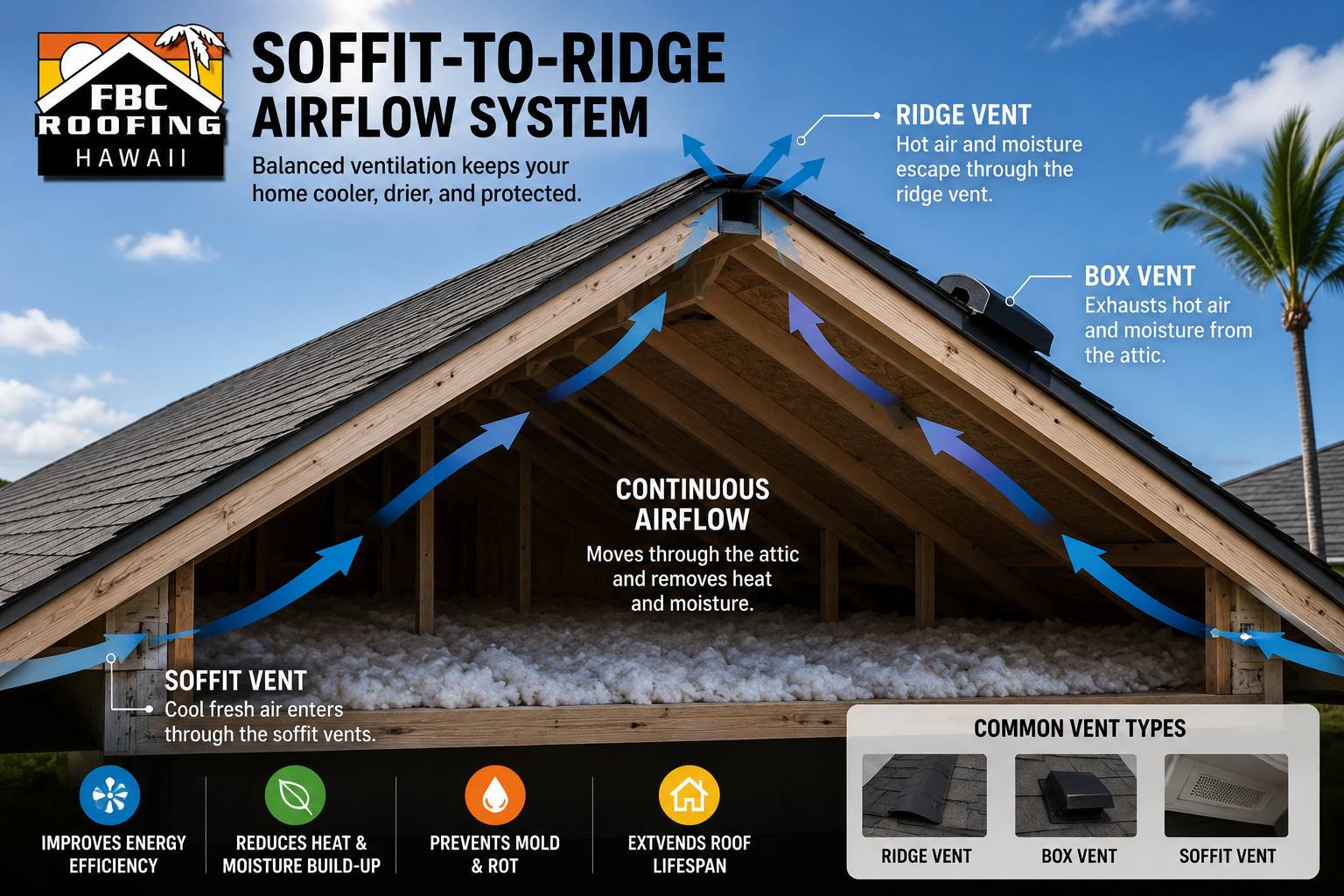
Effective roof ventilation relies on a process called natural convection. Cool air enters through intake vents positioned low on the roof (typically in the Soffit & Fascia), travels up through the attic space, and exits through exhaust vents at the peak. As attic air heats up, it rises and escapes, creating negative pressure that pulls fresh air in from below to prevent heat and moisture buildup.
The Critical Balance of Intake and Exhaust
For this cycle to function, your intake and exhaust must be perfectly balanced.
Too Much Exhaust: If you have more exhaust than intake, the system creates negative pressure that can pull air-conditioned air from your living space into the attic, spiking your energy bills.
Too Much Intake: If the exhaust is blocked or insufficient, hot air remains trapped at the peak, leading to stagnant "hot spots" that bake your shingles from the underside.
In Hawaii, attic temperatures regularly hit 140–160°C without proper ventilation—often 30°C hotter than well-ventilated spaces. When you combine this heat with year-round humidity above 70% and salt air that corrodes metal fasteners, poor ventilation rapidly accelerates roof deck deterioration and shingle failure. During tropical storms, balanced ventilation also prevents wind-driven rain infiltration by equalizing pressure differentials that can force water through roof penetrations.
The 1:150 Ventilation Rule Explained
Building codes require a specific ratio to ensure your home can "breathe." The standard is 1 square foot of net free ventilating area (NFA) for every 150 square feet of attic space.
The Calculation Mistake: Gross Area vs. Net Free Area (NFA)
Here's where many DIY projects and inexperienced contractors fail: confusing gross area with NFA. A vent's NFA is the actual open space for airflow after accounting for screens, louvers, and frames.
An NFA is typically only 50–70% of a vent's physical size.
For example, a 4"x16" soffit vent has 64 square inches of gross area but may only provide 25-30 square inches of actual airflow.
If you don't account for this, you’ll likely install 30–50% less ventilation than your roof actually needs.
Ventilation Requirements for Oahu Homes
FBC Hawaii's GAF Master Elite certification includes proper ventilation assessment during every free roof inspection, ensuring calculations account for NFA and meet Hawaii's specific building code requirements.
Choosing the Right Ventilation System for the 808 Climate
The architectural design of your home determines which system is most effective. At FBC Hawaii, our New Build experts assess your roof pitch and ridge length to customize your airflow.
Ridge Vents: The Gold Standard
Ridge vents are installed along the entire peak of the roof, allowing hot air to escape at the highest possible point. Quality ridge vents provide 18–20 square inches of NFA per linear foot and include external baffles to block wind-driven rain during tropical storms—an essential feature for Windward Oahu.
Alternatives for Complex Roof Designs
If your home has a hip roof or complex planes without a long ridge line, we may utilize:
Static Box Vents: These are spaced 10–12 feet apart in the upper third of the roof to provide 50-60 square inches of NFA per unit.
Drip Edge Vents: Ideal for older Oahu neighborhoods or plantation-style homes where eaves or soffits are minimized or non-existent.
Powered Attic Fans: While they consume energy (15-$40 monthly), they can be useful in specific Leeward heat scenarios, though passive ventilation is usually preferred for long-term reliability.
Turbine Vents: These work in theory but often have higher failure rates in Hawaii's salt-heavy coastal environments.
The Cost of Poor Ventilation: What Happens When Roofs Can't Breathe
Inadequate airflow is more than an inconvenience; it is a structural and financial liability.
Shingle Failure: Excessive heat (above 160°C) accelerates granule loss and causes "thermal cracking," breaking the adhesive seals that prevent Storm Damage Repair needs or total wind blow-offs.
Moisture & Rot: When humid air contacts a cooler roof deck, condensation occurs. In Hawaii’s humidity, poorly vented attics can maintain 25-30% moisture content, leading to mold and wood rot. Mold remediation can cost anywhere from $2,000 to over $10,000.
Corrosion: Salt air accelerates the corrosion of metal fasteners by 3-5 times in damp, unvented attics, weakening the structural integrity of your roof.
High Utility Bills: Trapped heat radiates into your living space, increasing cooling costs by 10–15% according to the Department of Energy.
Warranty Voids: Most shingle manufacturers—including GAF—require proper ventilation as a condition of their warranty. Without it, a Roof Replacement for premature failure could come entirely out of your pocket.
Signs Your Attic Ventilation Is Inadequate
You don't need to wait for a ceiling leak to know you have a problem. You can assess these issues before they cause major damage.
The Temperature Test: On a sunny afternoon, measure your attic temperature and compare it to the outside temperature. It shouldn’t be more than 10–20°C hotter than the outside air. If it’s 30°C or more above ambient, you have a ventilation crisis.
Rusty Nail Tips: Look for rust or water stains on the nails poking through the roof deck in your attic—this is a sure sign of chronic condensation.
Blocked Soffits: In 30–40% of homes, blown-in insulation accidentally blocks the intake vents, essentially "choking" the roof.
Shingle "Cupping": If you see shingle edges curling or "cupping" from the ground, your roof is likely being cooked from the inside out.
Musty Odors: A musty smell in the upper floors of your home often signals moisture accumulation in the attic.
Common Ventilation Mistakes to Avoid
The most damaging error is mixing exhaust types. Installing ridge vents alongside gable vents or powered fans actually "short-circuits" the airflow. Instead of air traveling from the soffit to the ridge, it takes the shortest path between the two exhaust vents, leaving large "dead zones" of stagnant, hot air in your attic that can reduce effectiveness by 60-70%.
Another frequent issue is improper installation during Roof Repair or maintenance. In Hawaii, vents must have external baffles; without them, high winds from the Trade Winds can force rain directly into your attic. Furthermore, even small gaps in ridge vent coverage (just 6-12 inches) can significantly degrade the entire system's performance.
Protect Your Investment with FBC Hawaii
Since 2009, FBC Hawaii has provided high-performance roofing solutions across Oahu, from single-family homes to complex multi-unit developments. As a GAF Master Elite certified team, our Roof Inspection process includes a comprehensive ventilation audit to ensure your home meets the 1:150 rule and is ready for the intense Hawaii summer.
Our 7-year workmanship warranty includes ventilation verification during every installation to protect your long-term investment. Don't let poor airflow destroy your roof. Whether you need a simple vent refresh or a complete Roof Replacement, our team has the local expertise to keep your home cool and dry.
Ventilation FAQ for Hawaii Homeowners
How do I know if my soffit vents are actually working? A simple "tissue test" can work. Hold a piece of tissue paper up to the soffit vent while the attic is hot; if the paper is pulled toward the vent, air is being drawn in. However, a professional Roof Inspection is the only way to be 100% sure.
Can I just install a bigger fan instead of more vents? We generally advise against this. While a fan may seem like a quick fix, it consumes electricity and can "short-circuit" the natural airflow if the intake isn't properly calculated. Passive systems are more reliable in the long run.
Does my gutter system affect ventilation? Indirectly, yes. If your Gutter Replacement or Gutter Repair is not done correctly, water can back up into the fascia and soffit area, potentially blocking or damaging intake vents. We recommend regular Gutter Cleanouts to keep the roof edge clear.
What if I have no eaves for soffit vents? We can install "smart vents" or drip edge vents that provide intake airflow at the roof's edge, even on homes without traditional overhangs.