
Attic Ventilation Oahu | Soffit Repair
Best Roofing Shingles Oahu | FBC Hawaii - Copy
The Science of Intake: How Soffit Vents Create Critical Airflow
How Excessive Heat Destroys Your Shingles (From the Inside Out)
The Humidity Factor: Why Soffit Vents are Critical for Mold Prevention
Signs Your Soffits are Blocked, Painted Shut, or Failing
The FBC Hawaii Solution: High-Flow Soffit Restoration
Is Your Attic "Cooking" Your Roof? The Critical Role of Soffit Vents in Hawaii Summer
As we move into May on Oahu, the temperature in an unventilated attic can easily skyrocket to a staggering 150°F or higher. Without a balanced, high-performance ventilation system, that heat has nowhere to go. When extreme heat is trapped in that confined space, it doesn't just make your air conditioner work harder—it literally "cooks" your roofing materials from the inside out. This phenomenon is a leading cause of premature roof failure across the islands.
At FBC Hawaii, we frequently encounter residential roofs that should have lasted 25 years but are failing after only 12. The culprit is almost always poor attic ventilation, specifically a lack of functional Soffit Vents. In the 808's unique climate of high humidity and intense UV, your soffits are the "lungs" of your home. If they are blocked, rotted, or non-existent, your roof’s "Foundation of Life" is in serious jeopardy. Understanding the synergy between your roof deck and your eaves is essential for any property owner looking to avoid a $20,000 replacement bill.
The Science of Intake: How Soffit Vents Create Critical Airflow
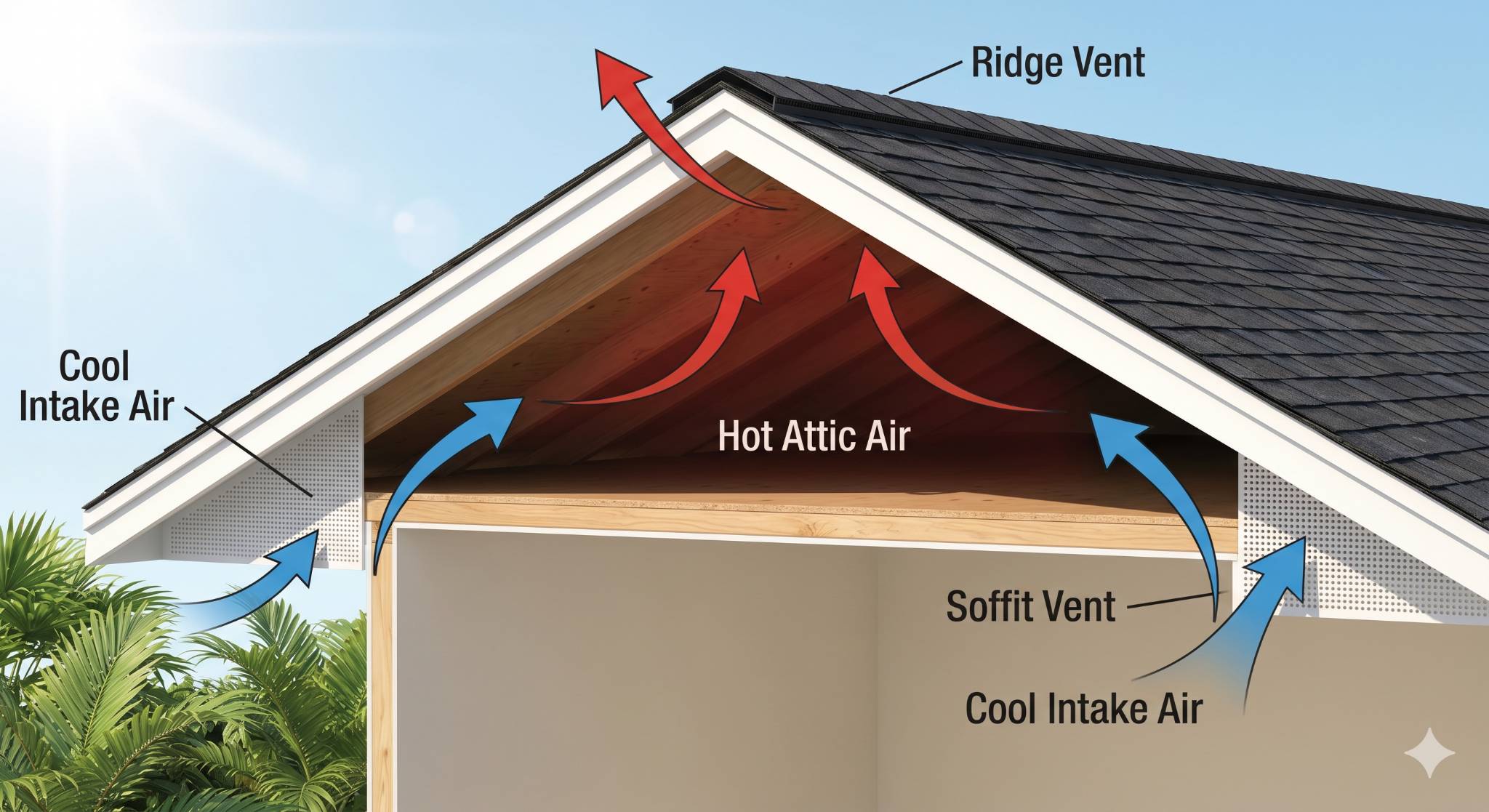
A healthy roof requires a continuous, passive cycle of airflow to regulate temperature and moisture levels. This is achieved through the Passive Ventilation principle, which relies on the natural movement of air without the need for mechanical fans. For this system to work effectively, you need two perfectly balanced components: an exhaust (usually located at the ridge or peak of the roof) and an intake (located at the eaves or soffits).
The Intake Engine of the Home
Soffit vents are located on the underside of your roof's overhang. Their primary job is to pull in cooler, outside air. Because hot air naturally rises (a process known as the stack effect), the cool air entering the soffits creates a "convection current." This current pushes the stagnant, 150°F attic air upward and out through the vents at the top of the roof.
The Danger of an Unbalanced System
If you have a ridge vent but your soffit vents are blocked by insulation or have been painted over, your roof cannot "breathe." This creates a dangerous vacuum effect. Instead of pulling air from the outside, the ridge vent will actually try to pull cool, air-conditioned air from your living space through light fixtures, attic hatches, and ceiling cracks. This effectively turns your home into a straw, sucking out your money and skyrocketing your monthly AC bill. FBC Hawaii specializes in calculating the exact Net Free Vent Area (NFVA) required to ensure your specific Oahu home stays pressurized, cool, and structurally sound.
How Excessive Heat Destroys Your Shingles (From the Inside Out)
When your attic is "cooking," the heat radiates upward into the plywood roof deck. This causes the asphalt in your shingles to reach temperatures far beyond their intended design specifications. Most homeowners worry about the sun hitting the top of the shingles, but the heat coming from the bottom is often more destructive.
Volatilization of Essential Oils: Asphalt shingles contain organic oils that keep them flexible and waterproof. Excessive attic heat "bakes" these oils out, leading to shingles that become brittle, crack, and lose their protective granules prematurely.
Adhesive Strip Failure: High heat can soften the sealant strips that bond shingles together. In the event of a High-Wind Kona Storm, these "cooked" shingles are the first to blow off because their adhesive bond has been compromised by chronic overheating.
Roof Deck Warping and Buckling: Constant heat saturation can cause the plywood decking to expand and contract violently. This leads to "buckling" shingles and a wavy roofline that is significantly more susceptible to leaks during heavy May trade wind showers.
The Humidity Factor: Why Soffit Vents are Critical for Mold Prevention
On Oahu, we don't just deal with heat; we deal with an average humidity level of 70% to 80%. When hot, moist air gets trapped in an unventilated attic, it reaches its "dew point" the moment the sun goes down and the exterior temperature drops.
The "Attic Rain" Phenomenon
At night, the moisture in the trapped air condenses on the underside of the cool roof deck, literally "raining" inside your attic. Because there is no airflow to dry this moisture, it sits on the wood, leading to:
Structural Wood Rot: Your rafters and roof deck begin to soften, lose their load-bearing capacity, and eventually decay.
Toxic Black Mold: Dark, damp, 100°F+ attics are the perfect breeding ground for mold spores, which can eventually migrate into your home’s HVAC system and living areas.
Insulation Saturation: Wet insulation loses its R-value, meaning it can no longer keep the heat out of your home, further increasing your cooling costs.
Properly functioning Soffit and Fascia systems ensure that this moisture is swept out of the attic before it has a chance to condense and cause structural damage.
Signs Your Soffits are Blocked, Painted Shut, or Failing
Many Oahu homes built in the 70s, 80s, and 90s have "passive" soffits that were never actually cut open during original construction, or they have been painted over so many times that the ventilation holes are sealed shut. Watch for these red flags this May:
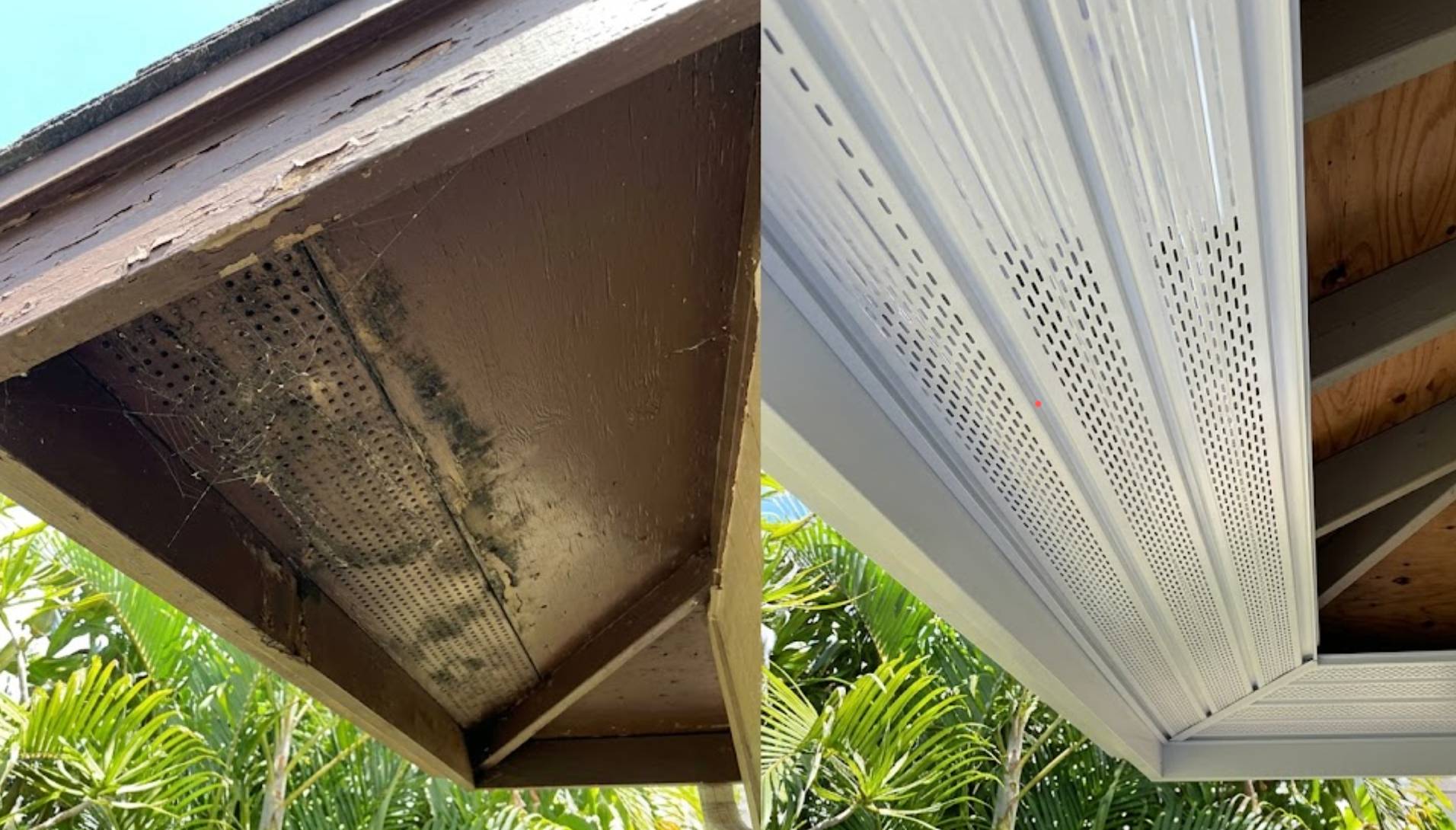
Peeling Paint on Eaves and Fascia: If the paint on your soffits or fascia is bubbling or flaking, it’s a sign that moisture is trying to escape from the inside of the wood.
Dark Stains, Algae, or Mildew: Look for black or green streaks on the underside of your eaves. This indicates trapped moisture and a total lack of airflow.
The "Oven Effect": If you open your attic hatch and feel a blast of heat similar to an industrial oven, your intake ventilation is likely non-functional.
Curling Shingles at the Eave Line: When shingles curl only at the very bottom of the roof, it’s often a sign that the wood underneath is staying damp due to blocked airflow at the intake.
The FBC Hawaii Solution: High-Flow Soffit Restoration
We don't just "poke holes" in your wood. As a GAF Master Elite Contractor, we provide engineered ventilation solutions that meet the specific requirements of the International Residential Code (IRC).
Full-Vented Soffit Upgrades: We replace old, rotted, or solid wood with high-performance, perforated aluminum or fiber-cement soffits. These materials are immune to termites, won't rot, and are specifically designed for salt-air environments like Ewa Beach and Kailua.
Baffle Installation: We ensure that your attic insulation isn't blocking the airflow. We install "rafter baffles" (or insulation dams) to keep the airway clear from the eave to the ridge, ensuring the air has a clear path to travel.
Fascia Integration: Since the fascia board holds your Gutter System, we ensure that any soffit repair includes a structural audit of the fascia to prevent gutter collapse during heavy tropical downpours.
Ventilation FAQ: Protecting Your Oahu Home Investment
Can I just install a solar attic fan to solve the heat problem? A solar fan is an "active" exhaust, but it still requires "intake" air to function. Without open, functional soffit vents, a solar fan will actually pull air out of your air-conditioned living space through the ceiling. You must fix your soffits first for any fan to be effective.
Do termites contribute to soffit failure? Absolutely. Subterranean termites love the damp, dark wood of unventilated eaves. By upgrading to non-organic materials or ensuring the wood stays dry through proper airflow, you significantly reduce the risk of a termite infestation in your roofline.
How much does it cost to repair or upgrade soffits on Oahu? Minor repairs or vent clearing can start as low as $600, while a full-home eave restoration varies by the size of the structure. However, considering a full roof replacement on Oahu can cost upwards of $15,000, spending a fraction of that on proper ventilation is the smartest financial move you can make this summer.
Does FBC Hawaii check ventilation during their free inspections? Yes. Everyfree roof inspection we perform includes a "Thermal and Moisture Audit" of your ventilation system. We use moisture meters and visual checks to ensure your roof isn't being cooked from the inside.
Don't Let Your Roof Burn Out This Summer
Your roof is your home’s most expensive and important asset. Don't let a series of blocked or painted-over vents be the reason it fails a decade early. This May, ensure your home can breathe easy before the true summer heat arrives. Protect your property, your family, and your wallet with the 808 ventilation experts.