
Flash Flood Ready Gutters Oahu | FBC
130mph Wind Proof Roof Oahu | FBC Hawaii - Copy
The 5-Inch vs. 6-Inch Debate: Why Size is the Deciding Factor on Oahu
Downspout "Exit Velocity" and Proper Sizing for 808 Storms
The Foundation Threat: Hydrostatic Pressure and Soil Erosion
High-Wind Gutter Security: Preventing "Gutter Rollover"
Tropical Debris and the "Clog Catalyst"
Oahu Flood Readiness Checklist: Audit Your System Today
Is Your Gutter System "Flash Flood" Ready? A Guide for Windward Oahu Homeowners
If you live in Kaneohe, Kailua, Manoa, or along the lush, rain-heavy valleys of the North Shore, you know that "rain" in Hawaii isn't always a gentle tropical mist. When a trade wind cell stalls against the Koʻolau Mountains or a "Kona Low" develops, Windward Oahu can experience 3 to 5 inches of rainfall in a single hour. During these extreme flash flood events, your roof transforms into a massive, high-velocity funnel.
To put the math into perspective: A standard 2,000-square-foot roof on Oahu will shed approximately 1,250 gallons of water for every single inch of rain that falls. In a 4-inch deluge—common during our winter months—your home must manage 5,000 gallons of water in 60 minutes. If your gutter system isn't specifically engineered to handle that massive volumetric flow, that water doesn't just "overflow"—it turns into a heavy waterfall that destroys your landscaping, rots your fascia, and creates hydrostatic pressure that can crack your foundation.
Since FBC Hawaii was established in 2014, we have specialized in high-capacity water management. We don't just "hang gutters"; we engineer total drainage solutions that protect your property from the unique climate of the 808. This guide will help you determine if your home is truly "Flash Flood Ready" or if you are at risk for a costly structural disaster.
The 5-Inch vs. 6-Inch Debate: Why Size is the Deciding Factor on Oahu
Most residential homes in the United States are built with standard 5-inch K-style gutters. While these may be sufficient for a light drizzle in a temperate climate, they are frequently overwhelmed by the "vertical rivers" we experience on the Windward side of Oahu.
The Volumetric Capacity Difference
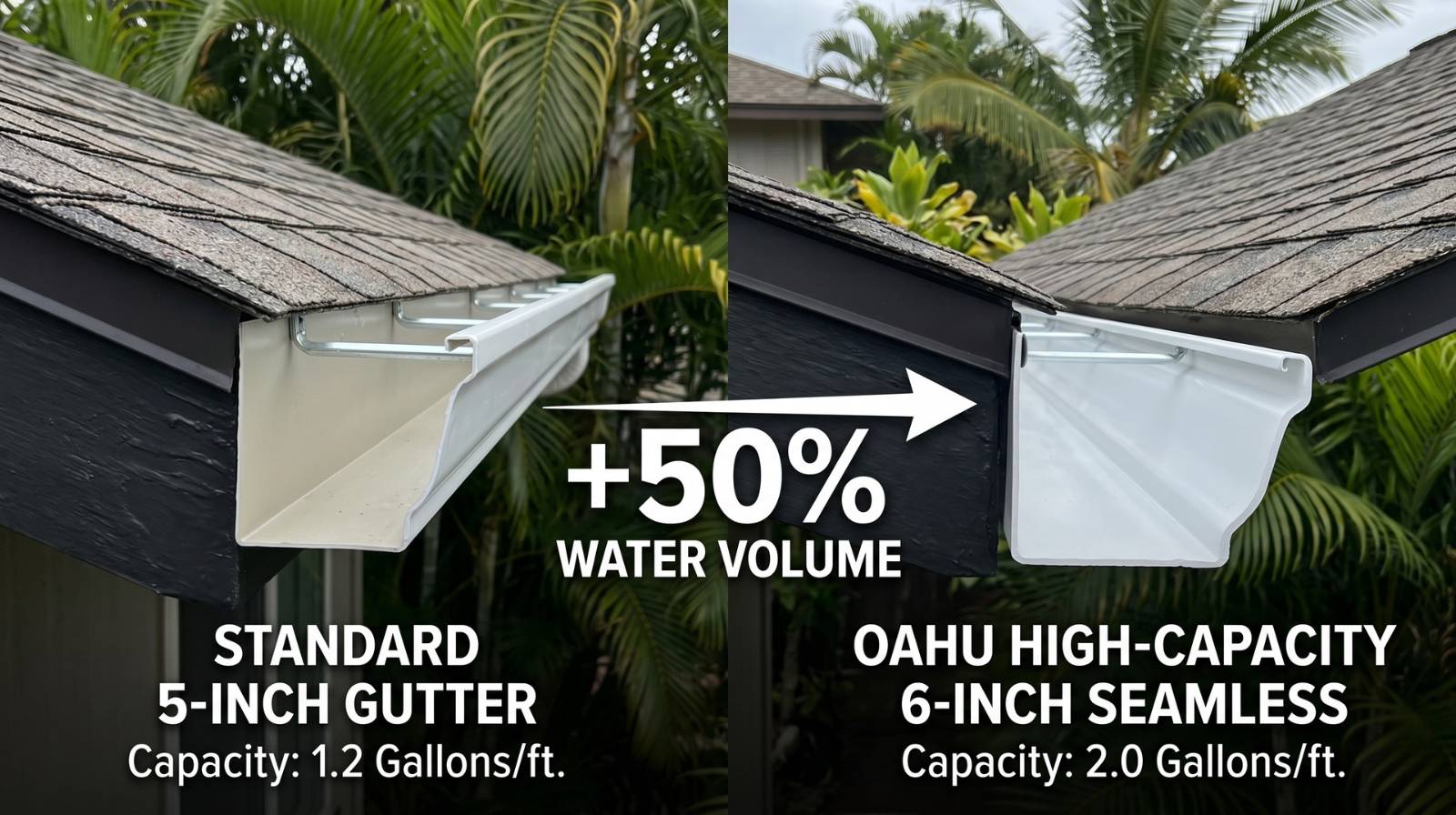
A 6-inch seamless gutter is not just "one inch bigger." Because of the way the trough is shaped, a 6-inch gutter can actually hold 50% more water volume than a 5-inch gutter. That extra capacity is the critical margin of safety during a tropical downpour. When a 5-inch gutter reaches its "breaching point," the water begins to spill over the back of the gutter, directly onto your Fascia and Soffit wood.
FBC Standard for High-Rainfall Zones
For properties in high-precipitation neighborhoods (like Nu'uanu, Ahuimanu, or the back of Palolo Valley), we almost exclusively recommend 6-inch high-capacity seamless aluminum gutters.
Hydraulic Efficiency: The wider trough allows water to move faster toward the downspouts, reducing the risk of "back-logging."
Tropical Debris Tolerance: Because 6-inch gutters have a wider opening, they are far less likely to be blocked by the large organic debris—such as mango leaves, avocado branches, and kukui nuts—that act as "clog catalysts" during a storm.
Downspout "Exit Velocity" and Proper Sizing for 808 Storms
The gutter trough is only the "collection" half of the equation. If the water cannot leave the gutter as fast as it enters, the entire system will back up into your eaves. This is where most DIY or "budget" gutter installations fail.
Upgrading to 3x4 Oversized Downspouts
Standard residential downspouts are typically 2" x 3". We find these to be woefully inadequate for Windward Oahu. At FBC Hawaii, we upgrade flood-prone homes to 3" x 4" oversized downspouts. * Increased Exit Velocity: The larger aperture allows for a significantly higher "exit velocity," ensuring that even during a peak deluge, the water is stripped away from the roofline immediately.
Point-Load Management: In Hawaii’s complex roof designs, water often concentrates in "valleys." These areas create a massive "point load" of water. We place our oversized downspouts specifically at these convergence points to prevent "splash-over" that leads to Roof Water Damage.
The Foundation Threat: Hydrostatic Pressure and Soil Erosion
When gutters fail during a flash flood, the water doesn't just disappear. It pools at the base of your home, creating a "moat" effect. This is the primary cause of foundation failure in Hawaii.
Hydrostatic Pressure and Concrete Cracking
Standing water creates Hydrostatic Pressure—a physical force that pushes moisture through solid concrete slabs and into your home’s crawlspace. Over time, this pressure causes "spalling" (concrete flaking) and can shift the very footings of your home.
Volcanic Soil Erosion: Oahu’s volcanic soil and red dirt are prone to rapid erosion. A single major storm event with failed gutters can create deep trenches around your home’s perimeter, exposing your foundation and inviting pests like Subterranean Termites into the damp wood.
The FBC Drainage Solution: We don't stop at the gutter. We ensure all downspouts feature 6-to-10-foot extensions or are connected to specialized underground drainage basins to move the "Flood Force" safely away from your structure.
High-Wind Gutter Security: Preventing "Gutter Rollover"
A flash flood on Oahu is rarely a calm event; it is almost always accompanied by gusty trade winds or Kona-style gusts. When a gutter fills to the brim with water, its weight increases exponentially, turning it into a structural burden for your home.
The Weight of Water
Water weighs approximately 8.34 pounds per gallon. A standard 40-foot gutter run filled with water and tropical sludge can put over 300 pounds of dead-weight stress on your fascia boards.
808-Ready Fastening Patterns: Standard mainland contractors space gutter hangers every 24 to 30 inches. Because of the weight and wind uplift on Oahu, FBC Hawaii spaces our heavy-duty hidden hangers every 16 to 18 inches. * Rafter Attachment: We don't just "nail into the board." We use heavy-duty screws that penetrate through the fascia and into the rafter tails whenever possible. This prevents the gutter from "rolling" or sagging under the combined weight of the water and the wind pressure.
Tropical Debris and the "Clog Catalyst"
In lush, Windward neighborhoods, foliage is the #1 enemy of a flood-ready gutter. A single palm frond or a handful of banyan leaves can turn your gutter into a bathtub in a matter of seconds.
Stainless Steel Micro-Mesh Protection
We recommend Gutter Guard systems that are engineered for high-flow environments. Our micro-mesh guards allow 6+ inches of rain to pass through per hour while keeping even the smallest tropical seeds out of your troughs.
The Seamless Advantage: We exclusively install Seamless Gutters fabricated on-site. Sectional gutters (the ones sold in 10-foot sticks at big-box stores) feature seams that act as "snags" for debris. These seams catch leaves, which then catch silt, which then grow a "gutter garden" that blocks your flow during a flood.
Oahu Flood Readiness Checklist: Audit Your System Today
Take a walk around your home before the next trade wind cell hits and look for these 4 signs of imminent water damage:
Tiger Striping: Dark, vertical "soot" lines on the outside of your gutters. This is proof that they are regularly overflowing and water is running down the face of the gutter.
Pulling Spikes: If you see large nails (spikes) pulling out of the wood, your fascia is likely rotting from chronic moisture.
Landscape Trenching: Look for visible "dips" or "holes" in the dirt, gravel, or grass directly under your roofline.
The "Musty" Smell: If your home or crawlspace smells musty after a rain, your gutters are likely dumping water too close to the foundation.
Why Choose FBC Hawaii for Your Water Management?
We have completed over 1,000 roofing and gutter projects across Oahu since 2014. As a GAF Master Elite Contractor, we understand the entire "Building Envelope"—from the ridge cap at the peak down to the final drainage exit at the street.
7-Year Workmanship Warranty: We are one of the only local companies that stands by our gutter installations for seven full years.
Island-Proven Engineering: We know the difference between the "Salt Air" needs of Ewa Beach and the "Heavy Flow" needs of Kaneohe.
Custom Fabrication: Our mobile gutter trucks allow us to create a single piece of aluminum for each side of your house—no leaks, no seams, no compromises.
“I was nervous at first, this was a multistep and multi-party project that required coordination. The team at FBC Roofing were responsive to my queries. They arrived on time, explained the roofing and gutter work clearly, and were very professional throughout the job. The roof looks perfect and the gutters are clean and sturdy. I am a demanding customer and appreciated the project manager's quick, direct response and ensuring the crew completed the work to my expectations. I would definitely recommend FBC Roofing to anyone needing reliable roofing services.” - Google Review
Flash Flood Gutter FAQ
1. Is it much more expensive to upgrade from 5-inch to 6-inch gutters? On average, the cost for 6-inch gutters is only 15–20% higher than standard gutters. However, the protection value they provide for a Hawaii home is nearly 100% higher during a storm.
2. Do I need a permit for gutter replacement on Oahu? In most cases, no. Gutter replacement and repair are considered "ordinary maintenance" and do not require a Honolulu building permit.
3. Can I just add more downspouts to my current 5-inch gutters? While adding downspouts helps, if the trough itself isn't wide enough to capture the "over-splash" from a steep roof during a heavy Hawaii rain, the water will simply jump over the gutter before it even reaches the downspout.
4. How long does a standard gutter installation take? Most residential gutter projects on Oahu are completed in one business day. We arrive in the morning and have you "Flood-Ready" by the time the afternoon trade showers arrive.
5. Does FBC offer free inspections? Yes. We provide a Free, No-Obligation Inspection where we calculate your roof's "Water Load" and provide a tailored plan for your property.
Don't Let the Next Rain Event Flood Your Foundation
Flash floods in Hawaii give no warnings. Ensure your home is ready to handle the volume before the next "Kona Low" develops. At FBC Hawaii, we diagnose your drainage weaknesses and provide the 808-Ready solutions you need for total peace of mind.