
Roofing Nails Guide Oahu | Stainless vs. Galvanized | FBC Hawaii
Roofing Nails Guide Oahu | Stainless vs. Galvanized | FBC Hawaii
Materials: Fighting the Salt-Air "Silent Killer"
Shank Types: Smooth vs. Ring Shank
Proper Nail Placement & Installation Techniques
3. Avoiding "The Three Big Mistakes"
Plastic Cap Nails: For Underlayment Only
Roofing Nails: The Expert Selection & Installation Guide for Hawaii
The wrong roofing nail can void your warranty, cause leaks, and turn a $15,000 roof into a $30,000 disaster. In Hawaii's salt air and high winds, choosing the right fastener isn't an "upgrade"—it’s a requirement for survival. At FBC Roofing & Exteriors, we’ve seen how improper nailing turns a Category 1 wind gust into a major insurance claim.
This guide covers the specific nail types, materials, and "808-Ready" techniques that prevent costly failures.
Materials: Fighting the Salt-Air "Silent Killer"
Standard nails fail in Hawaii because they aren't built for constant salt-spray exposure. Within three miles of the coastline (which covers a huge portion of Oahu), standard fasteners can corrode faster than your actual shingles.
The FBC Standard: As a GAF Master Elite Contractor, we specify Stainless Steel for any property within two miles of the coast. While the upfront cost is higher, spending an extra $800 on premium fasteners protects a $20,000 roof investment.
Shank Types: Smooth vs. Ring Shank
The "shank" is the body of the nail, and its texture determines how well it resists being pulled out by hurricane-force winds. In Hawaii, our roofs undergo extreme "thermal cycling"—the shingles heat up to 160°F in the midday sun and then cool rapidly during a 2 PM trade wind shower. This causes the wood deck to "breathe" (expand and contract), which can slowly push smooth nails out over time.
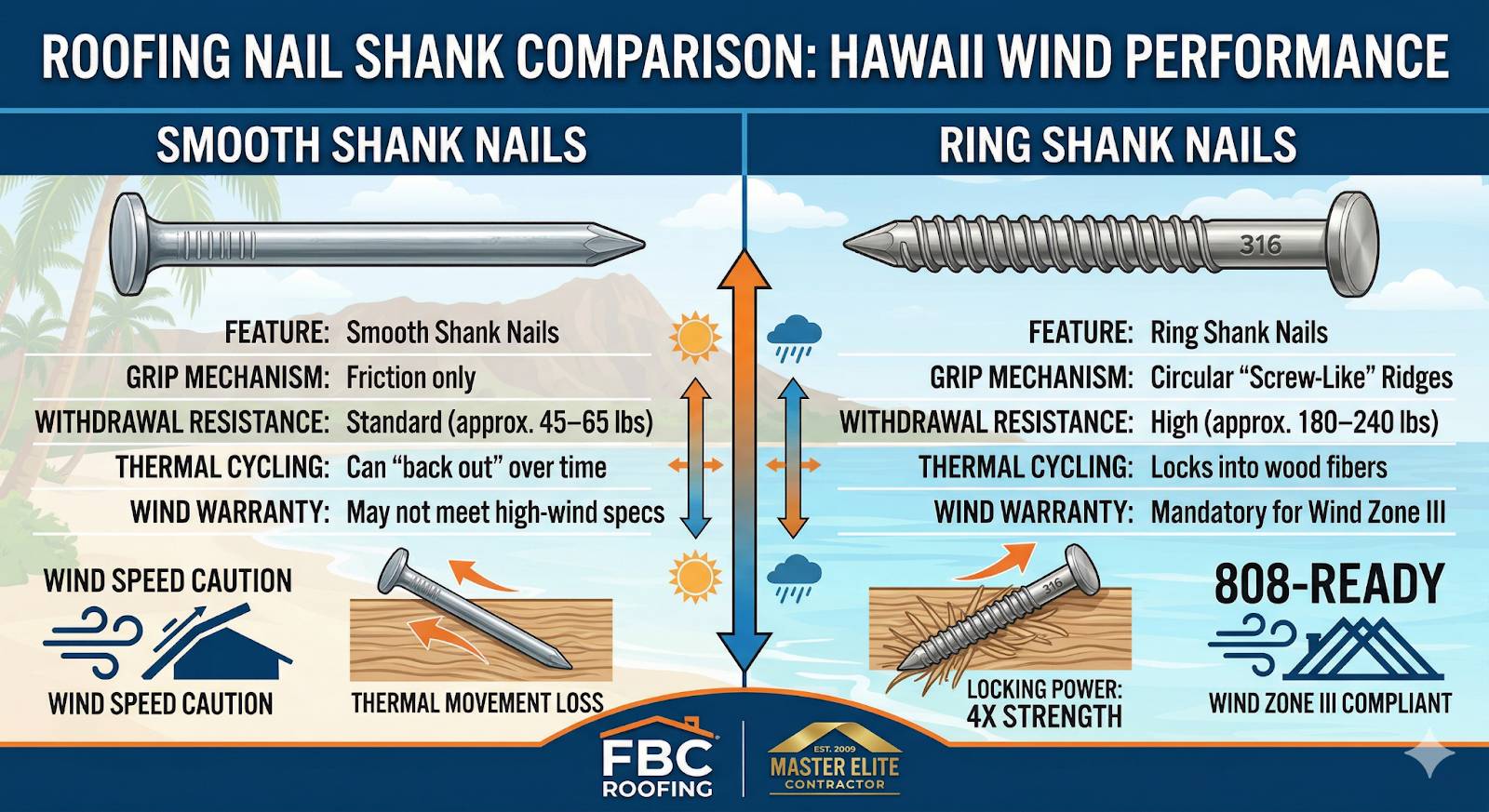
The FBC Standard: In Hawaii’s high-wind zones, Ring Shank nails are non-negotiable. A 1-1/4" ring shank nail delivers 4x the withdrawal resistance of a smooth nail. We’ve inspected too many failed roofs where contractors used smooth shanks to save $50 on a $20,000 project.
Proper Nail Placement & Installation Techniques
Nail placement determines whether your roof survives the next windstorm. Forensic studies by the Asphalt Roofing Manufacturers Association analyzed thousands of failures and found that nearly 80% involved improper fastening.
1. The "Nailing Zone"
The nailing zone on asphalt shingles sits 5/8" to 1" above the top edge of the cutout—typically marked on the shingle. Nails placed too high miss the underlying shingle layer, drastically reducing wind resistance. Nails placed in the adhesive strip prevent proper bonding and create leak pathways.
2. The "6-Nail" Rule
While standard mainland installs use 4 nails per shingle, the International Residential Code for high-wind zones (like Oahu) requires six nails per shingle. IBHS testing shows roofs with only four nails experience 2-3x higher failure rates in winds above 60 mph.
3. Avoiding "The Three Big Mistakes"
Overdriven: If the nail head breaks the shingle surface, it reduces holding power by 50%. You can spot this by the crushed granules around the head.
Underdriven: If the nail sits "proud" (above the shingle), it prevents the adhesive strip from sealing. This allows the wind to catch the shingle and rip it off like a sail.
Perpendicular Flush (The FBC Way): The head must sit perfectly flat against the shingle, creating a watertight gasket without breaking the surface.
Plastic Cap Nails: For Underlayment Only
You may see nails with large orange or green plastic heads. These are Cap Nails, and they serve one specific purpose: securing your underlayment (the "leak barrier") to the wood deck during our Roofing Services.
Why use them? The 1-inch plastic cap distributes the load across a larger surface area. This prevents the underlayment from tearing in the wind before the shingles are installed. Standard nails would simply punch through thin synthetic felt like a hole-puncher.
The Warning: Never use these for shingles. The plastic cap creates a visible bump that prevents shingles from sealing flat, completely ruining your roof's wind resistance. This is a common "DIY" error that leads to instant roof failure in high winds.
Work You Can Trust: Authentic Hawaii Reviews
We prioritize technical accuracy in every fastener we drive to protect your home.
“I had a great experience working with FBC Roofing. Michael Reynolds was super. He came to the home and walk us through their services and helped me a lot in working with my Insurance company. Once the scope of work and related cost and coverages were verified which included code upgrades, the process continued with selection of materials and color, etc.
The installation went very smoothly. The mainly Waianae Leeward coast boys worked well as a team and made sure to avoid obstacles such as the cable lines and everyone knew what they were doing. Any wood repairs were done nicely. They completed the roofing work in one day and cleaned up very well and made sure any waste was disposed of properly.
The roof looks great with no issues. I would highly recommend FBC Roofing for any roofing needs you may have.
Mahalo!” - Eric N, on Google Review
Roofing Nail FAQ
Visit our FAQ page for more technical details.
1. Can I use a nail gun or is hand-driving better? Pneumatic nail guns are the standard for speed, but they must be calibrated. FBC crews calibrate their tools every morning to match the specific roof deck, ensuring nails aren't overdriven or underdriven.
2. How many nails does a 2,000 sq. ft. roof need? For a 6-nail pattern in a high-wind zone, you'll need approximately 10,500 nails. This is roughly 40 lbs of stainless steel fasteners.
3. Will using the wrong nails void my GAF warranty? Yes. If a manufacturer like GAF finds that an unapproved fastener (like a non-corrosive-resistant nail in a salt zone) was used, they can deny your warranty claim.
4. What is "High Nailing"? This is when a nail is driven above the manufacturer's designated line. It is a major cause of roof failure because the nail only penetrates one layer of shingles instead of two, allowing the shingle to blow off easily.
5. How do I know if my current roof was nailed correctly? During our free roof inspections, we lift sample shingles to check for nail count, placement, and signs of corrosion.
Protect Your Foundation of Life
Don’t let a $2 box of nails ruin a $20,000 roof. At FBC Hawaii, we build specifically for the 808 environment, ensuring every fastener is a permanent shield for your home.
Is your roof held together by the right steel?