130mph Wind Proof Roof Oahu | FBC Hawaii
Gutter Overflow Solutions Oahu | FBC Hawaii - Copy
The Physics of the "6-Nail High-Wind Pattern"
GAF LayerLock™ Technology and the "Infinite" Wind Warranty
The "Unbreakable Seal": Starter Strips and Thermal Bonding
Synthetic Underlayment: The "Secondary Water Barrier"
Managing the "Vortex": High-Wind Ridge Caps
Oahu High-Wind Roofing Comparison: FBC vs. Standard
Wind Uplift 101: How FBC Hawaii Secures Shingles Against 130mph Kona Winds
In Hawaii, we are used to the gentle, cooling North-East trade winds that make our tropical climate so pleasant. However, when the pressure systems shift and the Kona Lows blow in from the Southwest, the physics of your roof’s performance changes entirely. Kona winds are notoriously turbulent, unpredictable, and often reach hurricane-force gusts that test the absolute limits of residential roofing materials and installation methods.
According to the latest 2026 Hawaii Building Code, most of Oahu is classified as a High Wind Zone, requiring roofs to withstand "Ultimate Design Wind Speeds" of up to 130 mph. However, a 130mph-rated shingle is only as strong as the mechanical bond created during installation. Since FBC Hawaii was established in 2014, we have perfected a "Hurricane-Hardened" process specifically for the 808 climate. We don't just "shingle" a roof; we engineer a defense system against the intense pressure differentials created by Pacific storms.
The Physics of the "6-Nail High-Wind Pattern"
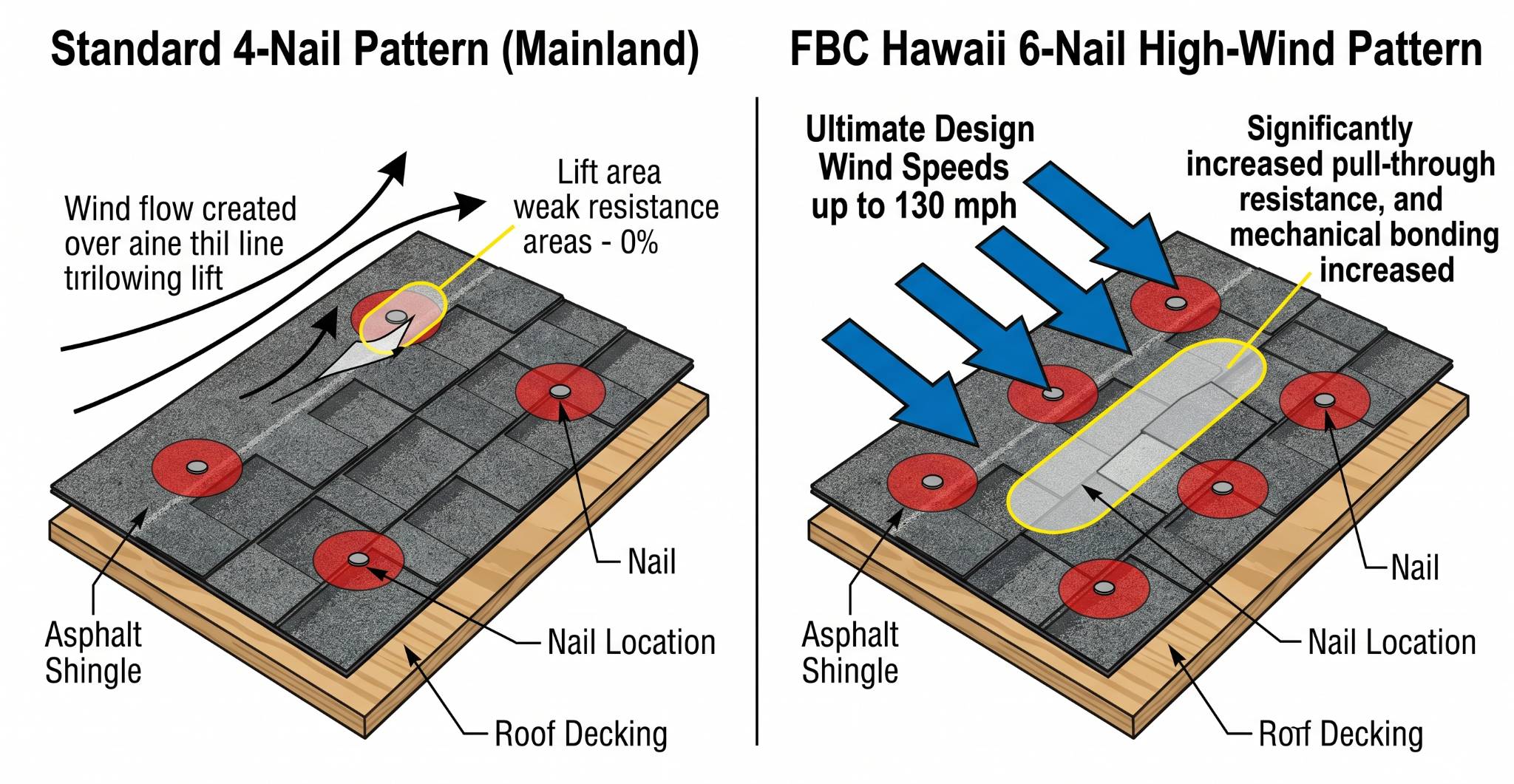
Most mainland contractors follow the standard manufacturer instruction of using four nails per shingle. While this might pass in a suburban neighborhood in the Midwest, it is a recipe for disaster on an Oahu hillside in Manoa or a coastal lot in Ewa Beach.
Why Six Nails is the Hawaii Standard
FBC Hawaii exclusively utilizes a 6-nail fastening pattern for every shingle we install. By adding two additional fasteners in the specific "High Wind Zone" of the shingle, we increase the shingle’s pull-through resistance by nearly 40%.
Mechanical Bonding: When wind travels over your roof, it creates a vacuum effect—much like an airplane wing—called Wind Uplift. This force tries to pull the shingles up and away from the roof deck.
The Strike Zone: Precision is key. We drive our high-grade fasteners exactly in the "strike zone"—the thickest part of the shingle where the layers overlap. This ensures maximum "grip" into the plywood decking, preventing shingles from "zippering" off during a sustained Kona gale.
GAF LayerLock™ Technology and the "Infinite" Wind Warranty
As a GAF Master Elite Contractor, FBC Hawaii has access to the most advanced shingle technology available: LayerLock™. This is the "secret sauce" that allows us to provide a level of security that standard contractors simply cannot match.
What is LayerLock?
Standard architectural shingles consist of two separate layers of asphalt bonded together with adhesive. High-velocity winds can cause these layers to "delaminate" or pull apart. GAF Timberline HDZ® shingles are mechanically bonded during the manufacturing process, creating a single, ultra-strong unit.
The WindProven™ Warranty: When we install these shingles with the required GAF accessories—including Starter Strips, Ridge Caps, and High-Performance Underlayment—your roof qualifies for the industry’s first WindProven™ Limited Wind Warranty.
No Maximum Wind Speed Limit: This is a game-changer for Oahu property owners. Whether the wind hits 100 mph or 150 mph, your roof is backed by a manufacturer guarantee that has no maximum wind speed limitation.
The "Unbreakable Seal": Starter Strips and Thermal Bonding
Most catastrophic roof failures during a hurricane don't start in the middle of the roof; they start at the leading edges (the eaves and rakes). If the wind can get under the first row of shingles, it acts like a crowbar, prying the entire system off the deck.
Pro-Start® vs. Flipped Shingles
Budget roofers often save money by "flipping over" a regular shingle to use as a starter row. This is a critical error. FBC Hawaii exclusively uses GAF Pro-Start® Starter Strips.
Factory-Applied Adhesive: These strips feature a concentrated bead of high-performance adhesive at the very edge of the roofline.
Solar Activation: In the intense Hawaii sun, these adhesive strips "melt" and bond the first row of shingles to the roof deck. This creates a watertight and wind-tight seal that prevents wind-driven rain and air pressure from penetrating the building envelope.
Synthetic Underlayment: The "Secondary Water Barrier"
If a once-in-a-generation storm managed to damage a shingle, your home shouldn't be left defenseless. This is where the quality of your underlayment becomes the difference between a minor repair and a total interior loss.
Synthetic Armor vs. Organic Felt
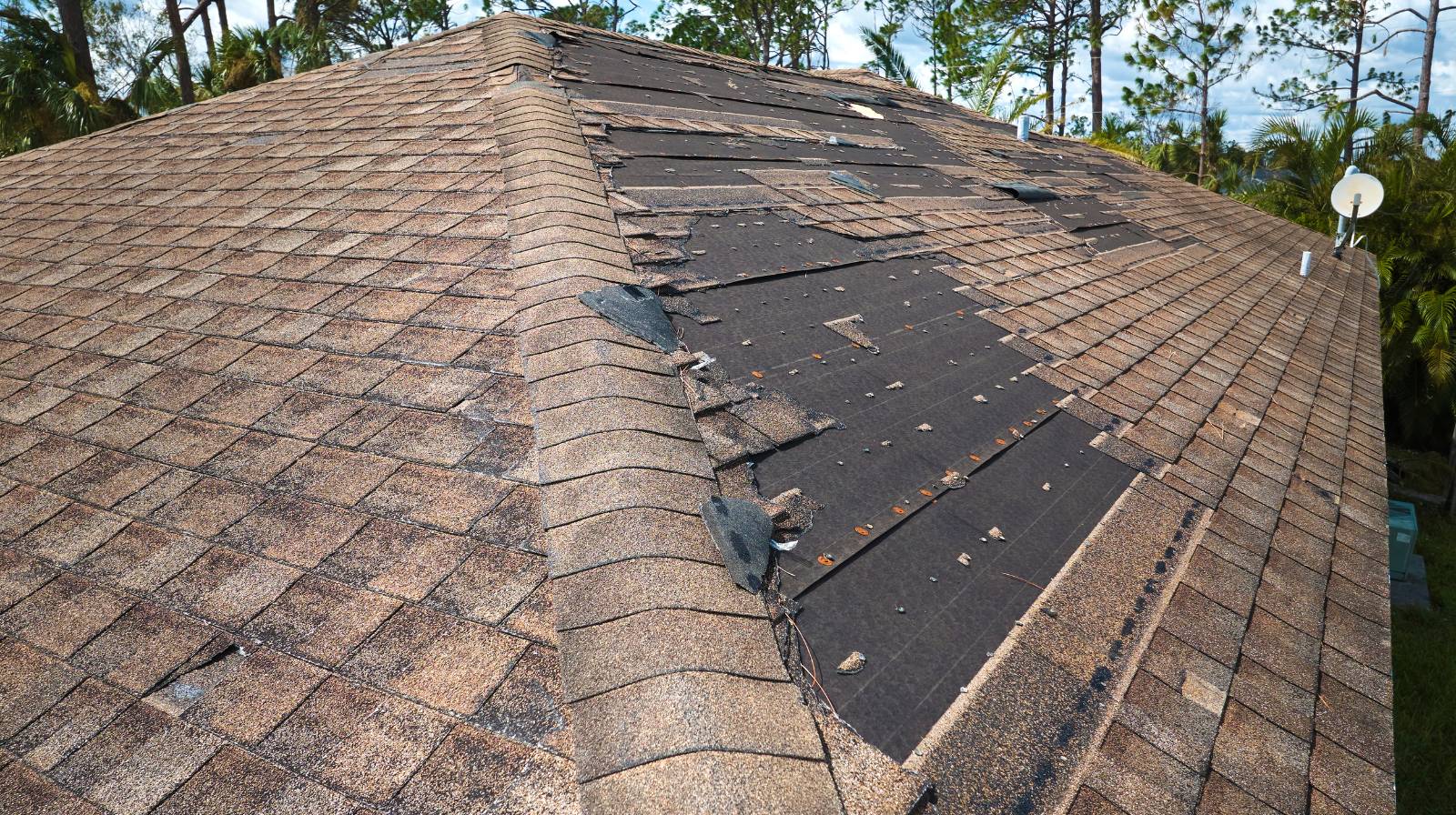
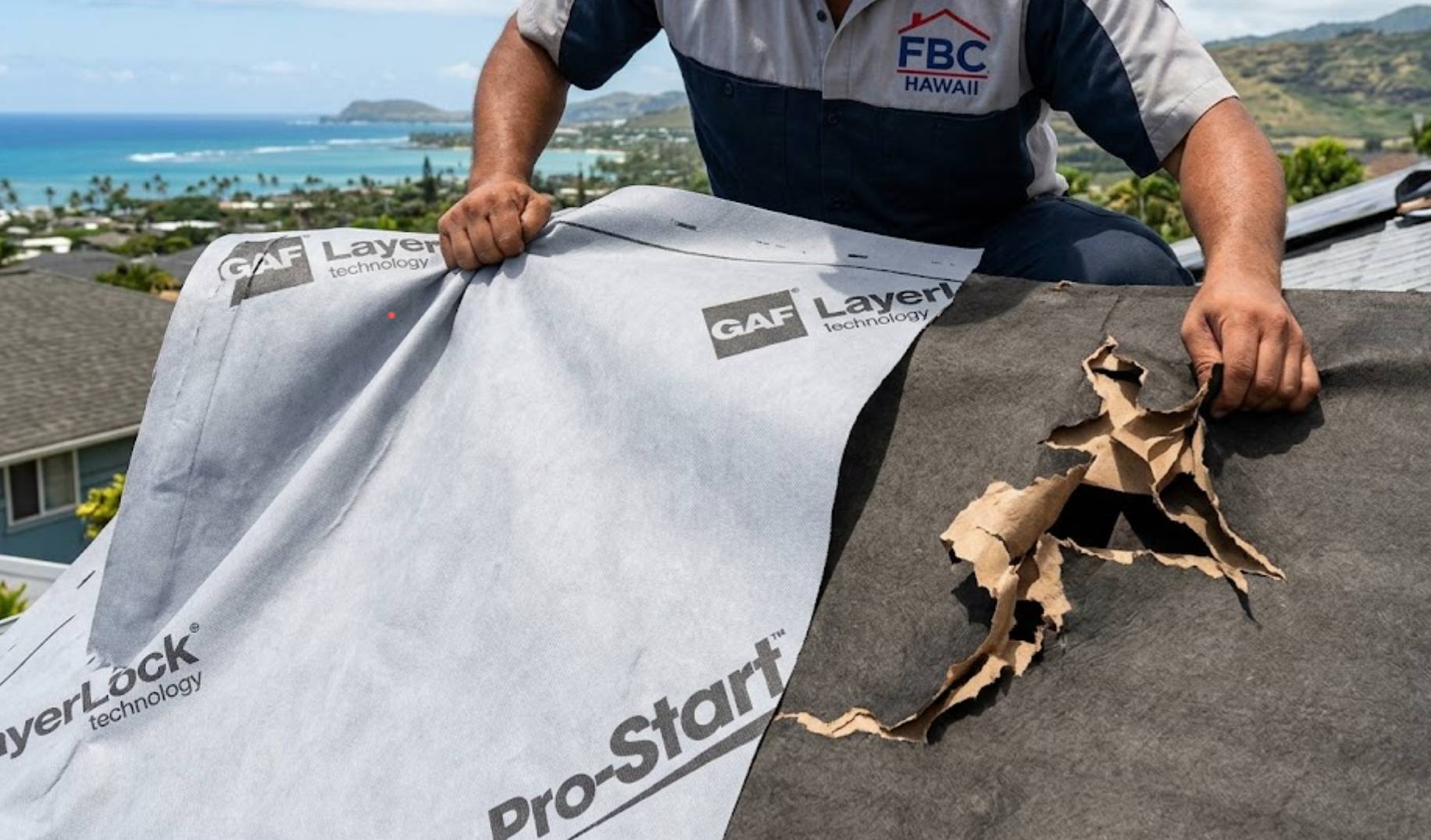
Traditional felt paper (tar paper) is an organic material. It is prone to tearing during installation and degrades rapidly in Hawaii’s 80% average humidity. If a shingle is lost during a storm, felt paper is often shredded in seconds by wind and rain.
FBC Synthetic Standard: We exclusively use High-Performance Synthetic Underlayment. This material is non-organic (won't rot), UV-resistant, and virtually impossible to tear by hand.
Secondary Shield: It acts as a secondary waterproof shield for your plywood deck. If a shingle is blown off, this synthetic armor keeps your attic and ceiling dry until the storm passes and a permanent repair can be made.
Managing the "Vortex": High-Wind Ridge Caps
The ridge—the very peak where two roof planes meet—is where wind turbulence is at its highest intensity. As the wind hits the side of your house and travels upward, it creates a "vortex" effect at the peak, exerting massive upward pressure.
The "Crown" of Your Home
Standard shingles are too thin and brittle to be folded over the peak as ridge caps. FBC Hawaii installs GAF Timbertex® or Seal-A-Ridge® cap shingles.
Dimensional Protection: These are thicker, pre-bent, and feature specialized adhesive strips that lock into the ridge.
Reinforced Fastening: We double-nail these caps with longer, heavy-duty roofing nails to ensure that the "crown" of your home remains secure even during the most violent Southwest Kona storms. This prevents the "peeling" effect that often starts at the top of the roof.
Oahu High-Wind Roofing Comparison: FBC vs. Standard
Understanding the technical differences helps you see why some roofs survive the storm while others fail.
Work You Can Trust: 1,000+ Oahu Roofs and Counting
We have completed over 1,000 projects across Oahu since 2014. Our team has seen firsthand how wind behaves in the tight valleys of Manoa, the wind-swept ridges of Hawaii Kai, and the salt-air corridors of Ewa Beach. We don't just build roofs; we build "808-Ready" defense systems that protect your property and your family.
“had in months. From the friendly phone call to the day the crew arrived, everything was organized and professional. They walked me through the shingle roof options, explained the process, and answered all my questions about roofing services. The installation was quick, clean, and the finished roof looks amazing. I love how the shingles line up perfectly and how quiet the house is inside now. I would definitely recommend them to anyone needing a roofing contractor or roof repair” - Google Review
High-Wind Roofing FAQ
1. Does a 6-nail pattern cost more than a standard installation? The additional material cost is minimal, but the labor takes longer because it requires 50% more precision nailing. However, when you consider that a 6-nail pattern can prevent a $20,000 total roof loss during a hurricane, the ROI is massive.
2. Is any roof truly "Hurricane-Proof"? No roof is 100% hurricane-proof, but a GAF Master Elite installation is "Hurricane-Hardened." It is designed to withstand the forces of a Category 1 or 2 hurricane without structural failure, which is the standard for Hawaii’s building codes.
3. Do I need special nails if I live in Ewa Beach or Kailua? Yes. For homes within 3 miles of the ocean, we highly recommend 316-grade stainless steel fasteners. Salt air can cause standard galvanized nails to "rust-jack," expanding and pushing the shingle up, which destroys the wind seal.
4. How can I tell if my current roof was installed for high winds? It is difficult to tell from the ground. We offer a Free, No-Obligation Roof Inspection where we can safely lift a few sample tabs to verify your nail pattern and adhesive health.
5. Will my insurance company offer a discount for this type of installation? Many Hawaii insurance carriers provide "Hurricane Mitigation" credits for roofs installed with 6-nail patterns and hurricane clips. We provide the full documentation you need to submit to your agent for these potential savings.
Don't Wait for the Next Kona Low—Get Your Inspection Today
The Kona winds are an inevitable part of life on Oahu. Ensure your roof is ready to stand its ground before the next storm warning is issued. At FBC Hawaii, we specialize in diagnosing the structural weaknesses in older roof systems and providing the high-wind upgrades needed for total peace of mind.